
RICE vs MoSCoW vs Kano: Which Prioritisation Framework Should You Use?
Product teams rarely suffer from a shortage of ideas. The real challenge is deciding which ideas deserve attention first.
Customers request new features, stakeholders have urgent priorities, technical teams raise quality concerns and business leaders expect measurable results. When everything appears important, Product Owners need a structured way to compare options and explain their decisions.
RICE, MoSCoW and Kano are three widely used prioritisation frameworks. However, they solve different problems:
- RICE compares opportunities using reach, impact, confidence and effort.
- MoSCoW separates essential work from work that can be deferred.
- Kano examines how different features influence customer satisfaction.
Understanding these differences can help Product Owners select the right framework—or combine them when one method is insufficient.
Why Is Product Prioritisation Important?
Prioritisation helps a product team decide where to invest its limited time, budget and capacity. Without a clear approach, teams may:
- Select work based on the loudest stakeholder
- Treat every requirement as urgent
- Spend time on low-impact features
- Neglect essential technical or compliance work
- Build features that customers do not value
- Change priorities without a clear reason
- Struggle to communicate why one item was chosen over another
A prioritisation framework does not make the decision automatically. It provides a transparent structure for discussion and exposes the assumptions behind a decision.
What Is the RICE Prioritisation Framework?
RICE is a scoring method used to compare product ideas, features, experiments and initiatives. The name represents four factors:
- Reach
- Impact
- Confidence
- Effort
The RICE score is calculated using the following formula:
RICE Score=Reach×Impact×ConfidenceEffort\text{RICE Score} = \frac{\text{Reach} \times \text{Impact} \times \text{Confidence}}{\text{Effort}}
A higher score suggests that an initiative may provide more expected value relative to the effort required.
Reach
Reach estimates how many users, transactions or accounts will be affected within a defined period.
Examples include:
- Number of users affected each month
- Number of customer accounts affected per quarter
- Number of support requests reduced
- Number of transactions improved
Reach should always include a unit and timeframe. “500 users per month” is more useful than simply writing “high reach.”
Impact
Impact estimates how strongly the initiative may affect the desired outcome.
Teams sometimes use a relative scale such as:
- 3 = massive impact
- 2 = high impact
- 1 = medium impact
- 0.5 = low impact
- 0.25 = minimal impact
The desired outcome should be clearly defined. Impact could relate to activation, customer retention, conversion, satisfaction or another product goal.
Confidence
Confidence accounts for uncertainty in the reach and impact estimates.
A team might use:
- 100% = high confidence
- 80% = medium confidence
- 50% = low confidence
Evidence from product analytics, customer research or experiments may support higher confidence. An assumption based mainly on stakeholder opinion should generally receive lower confidence.
Effort
Effort estimates the total work required from design, development, testing, research, operations and other contributors.
It may be measured in person-months, person-weeks or another consistently applied unit.
Example of RICE Scoring
Suppose a product team is comparing three features for a project-management platform:
| Feature | Reach | Impact | Confidence | Effort | RICE score |
| Single sign-on | 500 | 2 | 90% | 4 | 225 |
| Dark mode | 800 | 0.5 | 80% | 2 | 160 |
| AI meeting summaries | 400 | 3 | 60% | 6 | 120 |
Based only on the RICE scores, single sign-on would rank first.
However, this score does not automatically settle the decision. If single sign-on is necessary to meet a contractual or security requirement, its importance comes from more than numerical impact. This is where another framework, such as MoSCoW, may provide useful context.
Advantages of RICE
- Creates a comparable score
- Considers potential value and effort
- Makes assumptions visible
- Includes a confidence adjustment
- Works well with a large number of feature ideas
- Supports evidence-based conversations
Limitations of RICE
- Scores can create false precision
- Reach and impact may be difficult to estimate
- Teams may manipulate inputs to support a preferred feature
- Regulatory and technical necessities may score poorly
- It requires reasonably consistent product data
- A high score does not guarantee strategic alignment
RICE is most useful when the team has enough evidence to make reasonable estimates and needs to rank several competing opportunities.
What Is MoSCoW Prioritisation?
MoSCoW is a qualitative framework that groups requirements into four categories:
- Must Have
- Should Have
- Could Have
- Won’t Have This Time
The method is particularly helpful when a team is working towards a defined release, deadline or timebox.
Must Have
A Must Have is essential for the solution or release to be viable.
Examples include:
- Legal or regulatory requirements
- Critical security controls
- Capabilities without which the product cannot operate
- Contractually required functionality
- Work required to prevent unacceptable risk
A useful question is:
What happens if this item is not delivered?
If the release cannot proceed without it, the item may genuinely be a Must Have.
Should Have
A Should Have is important but not essential for immediate viability. Its absence may create inconvenience, inefficiency or a temporary workaround, but the release can still proceed.
Could Have
A Could Have is desirable but has a smaller effect if delayed. These items provide flexibility when time or capacity becomes constrained.
Won’t Have This Time
This category identifies work that is explicitly excluded from the current scope or timeframe. It does not necessarily mean the item will never be developed.
The Agile Business Consortium describes MoSCoW as a method for deciding what must be delivered now and what can wait within a fixed timeframe. Agile Business Consortium
Example of MoSCoW Prioritisation
Using the earlier project-management platform example:
| Category | Feature | Reason |
| Must Have | Single sign-on | Required for an enterprise contract |
| Should Have | AI meeting summaries | Supports a strategic productivity goal |
| Could Have | Dark mode | Valuable to users but not essential for the release |
| Won’t Have This Time | Custom themes | Deferred to protect the current release scope |
MoSCoW makes the release commitment clearer than a numerical score alone.
Advantages of MoSCoW
- Simple to understand and communicate
- Works well for releases and fixed deadlines
- Makes non-essential scope visible
- Helps protect a minimum viable outcome
- Encourages stakeholders to discuss necessity
- Clearly states what is out of scope
Limitations of MoSCoW
- Stakeholders may classify everything as a Must Have
- Items within the same category are not ranked
- It does not directly consider effort
- It provides limited support for comparing expected customer impact
- Category definitions may be applied inconsistently
- Political influence can affect classification
MoSCoW works best when the team agrees on strict definitions and limits the number of Must Have requirements.
What Is the Kano Model?
The Kano Model examines how product features influence customer satisfaction. It recognises that not every feature creates satisfaction in the same way.
The principal categories include:
- Basic features
- Performance features
- Excitement features
- Indifferent features
- Reverse features
Basic Features
Basic features are expected by customers. Their presence may not significantly increase satisfaction, but their absence creates strong dissatisfaction.
Examples include:
- Secure login
- Accurate billing
- Reliable payment processing
- Basic privacy controls
Customers may not praise a banking application for keeping their information secure, but they would be highly dissatisfied if it did not.
Performance Features
Performance features have a more direct relationship with satisfaction: the better the performance, the more satisfied customers are likely to become.
Examples include:
- Faster loading time
- Longer battery life
- More storage
- Quicker customer support
Excitement Features
Excitement features, or delighters, are unexpected capabilities that may produce a strong positive response. Customers may not be dissatisfied if these features are absent because they did not expect them.
Examples might include:
- An unexpectedly useful automation
- A personalised recommendation
- A thoughtful time-saving feature
- A feature that solves an unexpressed need
Indifferent Features
These features make little difference to customer satisfaction. Building them may consume resources without providing meaningful customer value.
Reverse Features
A reverse feature satisfies some users but makes the experience worse for others. An example could be an automated function that some customers appreciate while others consider intrusive.
How Is Kano Analysis Conducted?
Kano analysis is typically based on customer research. Users are asked two questions about each proposed feature:
- How would you feel if the feature were available?
- How would you feel if the feature were not available?
The combination of answers helps classify the feature.
This makes Kano different from a stakeholder workshop based only on internal opinion. Reliable classification requires input from relevant customers.
Advantages of the Kano Model
- Focuses directly on customer satisfaction
- Separates expected features from delighters
- Helps identify features customers may not explicitly request
- Highlights low-value or indifferent features
- Supports customer-centred product discovery
- Helps balance reliability and innovation
Limitations of the Kano Model
- Requires customer research
- Survey design and interpretation can be difficult
- It does not directly account for effort or cost
- Customer expectations change over time
- A delighter can eventually become a basic expectation
- Different customer segments may classify the same feature differently
Kano is most useful when a team wants to understand customer expectations and identify opportunities for differentiation.
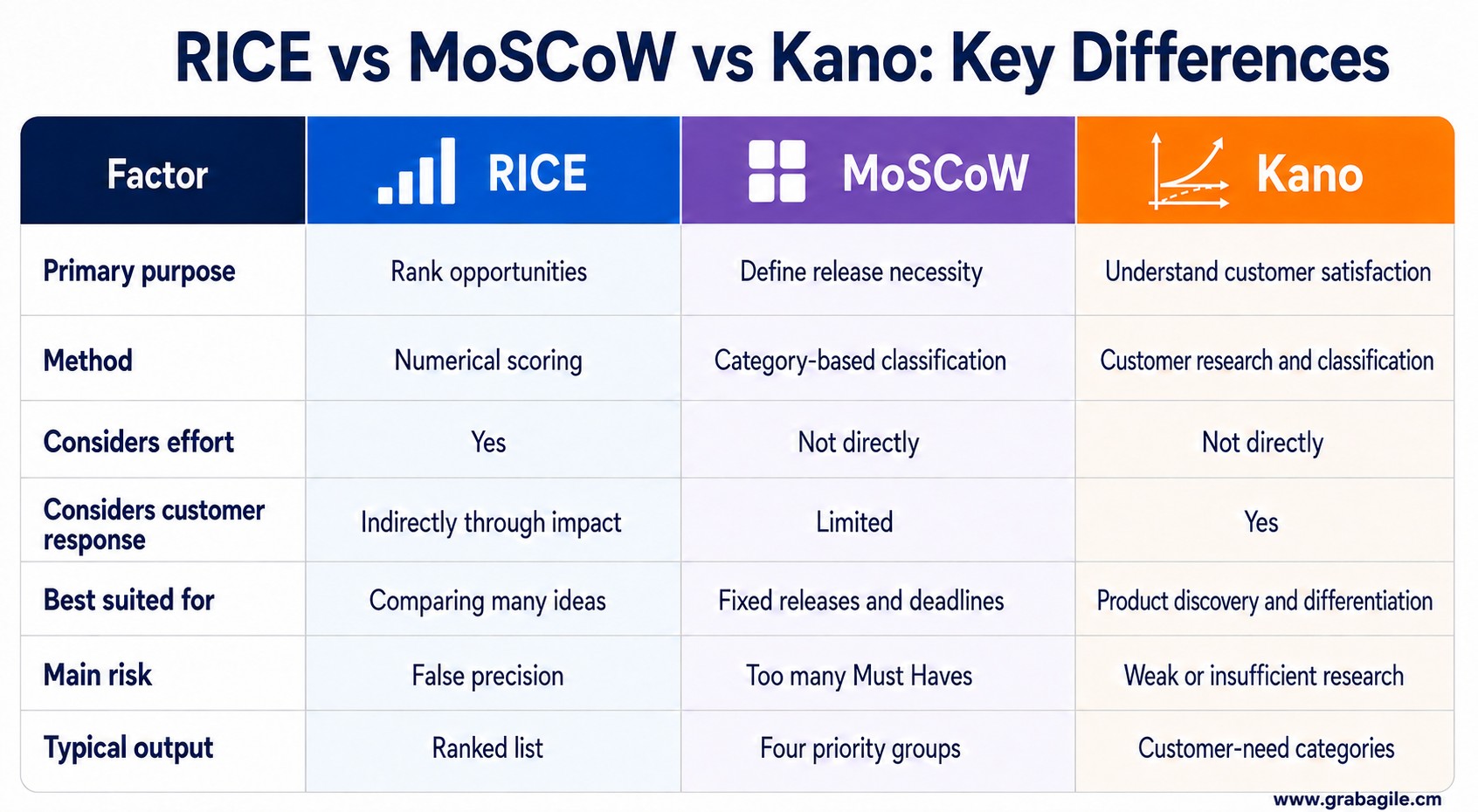
RICE vs MoSCoW vs Kano: Key Differences
| Factor | RICE | MoSCoW | Kano |
| Primary purpose | Rank opportunities | Define release necessity | Understand customer satisfaction |
| Method | Numerical scoring | Category-based classification | Customer research and classification |
| Considers effort | Yes | Not directly | Not directly |
| Considers customer response | Indirectly through impact | Limited | Yes |
| Best suited for | Comparing many ideas | Fixed releases and deadlines | Product discovery and differentiation |
| Main risk | False precision | Too many Must Haves | Weak or insufficient research |
| Typical output | Ranked list | Four priority groups | Customer-need categories |
Which Framework Should You Use?
Use RICE When:
- You have many competing product ideas
- Reach and impact can be reasonably estimated
- You need to compare value against effort
- The team has access to analytics or research
- Stakeholders want a transparent numerical ranking
Use MoSCoW When:
- A release has a fixed deadline
- The team must define minimum viable scope
- Stakeholders need clarity about what is included
- There must be room to remove lower-priority items
- Legal, contractual or operational requirements are involved
Use Kano When:
- You want to understand customer expectations
- The team is exploring product differentiation
- You need to separate basic needs from delighters
- Customer satisfaction is the primary consideration
- You have access to relevant users for research
Can the Frameworks Be Combined?
Yes. In many situations, using the frameworks together produces a better decision than relying on only one.
A practical sequence is:
Step 1: Use Kano to Understand Customer Needs
Identify which features are basic expectations, performance improvements, delighters or indifferent to customers.
Step 2: Use RICE to Compare Opportunities
Estimate the reach, impact, confidence and effort of the features worth considering.
Step 3: Use MoSCoW to Define Release Scope
After ranking the opportunities, classify which items are essential for the current release and which can be delayed.
For example, Kano may reveal that strong account security is a basic expectation, while AI-generated summaries are a delighter. RICE may then compare their expected impact and cost. Finally, MoSCoW may classify security work as a Must Have and the AI feature as a Could or Should Have for the current release.
Common Prioritisation Mistakes to Avoid
Treating Framework Results as Final Decisions
A high RICE score or Kano classification is an input—not an automatic decision. Strategy, technical risk and organisational context still matter.
Allowing Everything to Become a Must Have
When every requirement is essential, MoSCoW loses its value. Teams should apply a strict viability test to Must Have items.
Using Unsupported Estimates
RICE becomes unreliable when reach, impact and confidence are based entirely on opinion. Document the source of each estimate.
Ignoring Customer Segments
A feature may be essential for enterprise customers but irrelevant to individual users. Kano research should distinguish between important customer groups.
Forgetting That Priorities Change
Customer expectations, business strategy, market conditions and technical constraints change. Prioritisation should be revisited as new evidence becomes available.
Ignoring Technical and Quality Work
Not every important item produces an immediately visible customer benefit. Security, reliability, technical debt and compliance work must be considered alongside feature requests.
What Is the Product Owner’s Role?
The Product Owner is accountable for maximising the value of the product and for effective Product Backlog management. Prioritisation frameworks can support this work, but they do not transfer accountability to a formula, workshop or committee.
A Product Owner should:
- Clarify the Product Goal
- Connect prioritisation criteria to strategy
- Gather evidence from customers and product data
- Make assumptions transparent
- Include technical and risk-related considerations
- Communicate why priorities changed
- Ensure the Product Backlog remains visible and understood
- Reassess decisions when new information emerges
Prioritisation is most effective when it supports conversation rather than replacing it.
Conclusion
RICE, MoSCoW and Kano are not competing versions of the same method. Each answers a different question:
- RICE: Which opportunity offers the strongest expected value relative to effort?
- MoSCoW: What must be included in this release, and what can wait?
- Kano: How will this feature affect customer satisfaction?
Product Owners can choose the method that best matches the decision they are trying to make. They can also combine all three to connect customer needs, expected impact and release constraints.
Professionals who want to strengthen product strategy, backlog management and prioritisation skills can explore GrabAgile’s Product Owner training programmes.
GrabAgile
Phone: +1 (832) 990-2838 | +1 (870) 800-9533
Address: 1507 Lampman Court, Cheyenne, WY 82007, USA
Website: www.grabagile.com
Training schedule: View upcoming courses