
The Product Owner is a leadership role within the Agile team which ensures the management of the Product Backlog. The Product Owner works with the development team, stakeholders, as well as other leadership positions like Product Manager, which transform the business needs into a prioritized work backlog that is to be executed incrementally during sprints.
In this step-by-step guide, on how to become a Product Owner will be described in terms of what skills are needed, day-to-day activities of the person in this role, benefits of certification tracks, average salary across the United States, as well as how to prepare for interviews. It will also explain how to become a Product Owner with no experience by using the skills that can be transferred from similar fields.
The job outlook in this profession looks promising. As more companies implement Agile, high demand for this position is awaiting, and career growth as a Product Owner has more room now than it did five years ago.
Essential Skills to become a Product Owner
Before obtaining a certification, a future Product Owner Role needs all the skill set. When a potential employer is hiring someone for a Product Owner role, he or she looks at a candidate’s ability to prioritize things, communicate well, and be able to make decisions in situations of stress. The job requires certain competencies, and having Agile experience all these prevails over an impressive resume.
- Agile & Scrum Knowledge: Formal development skills are not necessarily required but it is important to know how the Agile framework works. It includes knowledge about sprints, ceremonies, velocity, and how Scrum Team self-organizes around the goal. Improvement of these competencies is required in order to perform the duties of a Product Owner in the Agile world.
- Backlog management: This competency being able to prioritize the backlog is one of the most important skills. Without being able to rank fifty competing requests, it is difficult to be a good Product Owner.
- Communication Skills: A Product Owner should have excellent communication skills. He or she has to translate from the language of business to that of Agile engineers and vice versa.
- Decision making and Analytical skill: Data-based product decisions need to be made instead of the decisions based only on intuition. With data analysis, assumptions can be checked before being implemented in the form of development work. Decision-making is a kind of competence that is tightly related to project management experience.
- Stakeholder Management: It takes negotiation of conflicting interests to be able to collaborate with various stakeholders, which include leadership, sales, support, and customers. Maintaining the trust of the team while operating under conflicting interests is a skill that one develops over time. Also, cooperation with the Scrum Master is even deeper as there is an overlap between prioritization and processes.
- User Stories: Properly written user stories along with proper acceptance criteria help take an abstract idea and turn it into something that can be built by the developers.
- Transferable Skills: If you’re transitioning from customer support, business analysis, or teaching, have transferable skills that are needed for this job, such as prioritization and communication with stakeholders.
What Are a Product Owner’s Day-to-Day Roles & Responsibilities?
These responsibilities relate to managing the product backlog and do not include holding meetings. The below-listed subsections give an overview of the daily responsibilities important for this role .
- Product Backlog Refinement: Every working day starts with the product backlog refinement and includes evaluation of new requests, priority changes, and preparing the highest priority requests for the development team to implement in the nearest sprint.
- Writing and refining User Stories: Before the start of each sprint, the top-priority items should be accompanied by properly written User Stories and Acceptance Criteria.
- Attending the Scrum ceremonies: These events include sprint planning, the daily stand-up, sprint review, and retrospective. The sprint review is the event where the Product Owner shows the completed product and gathers feedback. While the Scrum Master usually conducts such ceremonies, the Product Owner is responsible for the contents; this will become obvious after a couple of sprints together with a Scrum Master. These daily tasks can hardly be summed up to two days since they are spread through the whole sprint.
- Communication with Stakeholders: This activity occupies quite a large share of the week including demands of Sales to add new features, bug pattern reports from the Support, and information from Leadership. The difficulty is to balance all these voices so that they would not overshadow the roadmap is a daily task.
- Working with the Development Team: Even though the Product Owner does not manage the engineers, they are the key person when the cross-functional team faces an unclear requirement mid-sprint.
- Updating the product roadmap: The product roadmap and product vision has to be regularly updated aligning with changing priorities, competition, or customer feedback.
Your Roadmap to Becoming a Product Owner
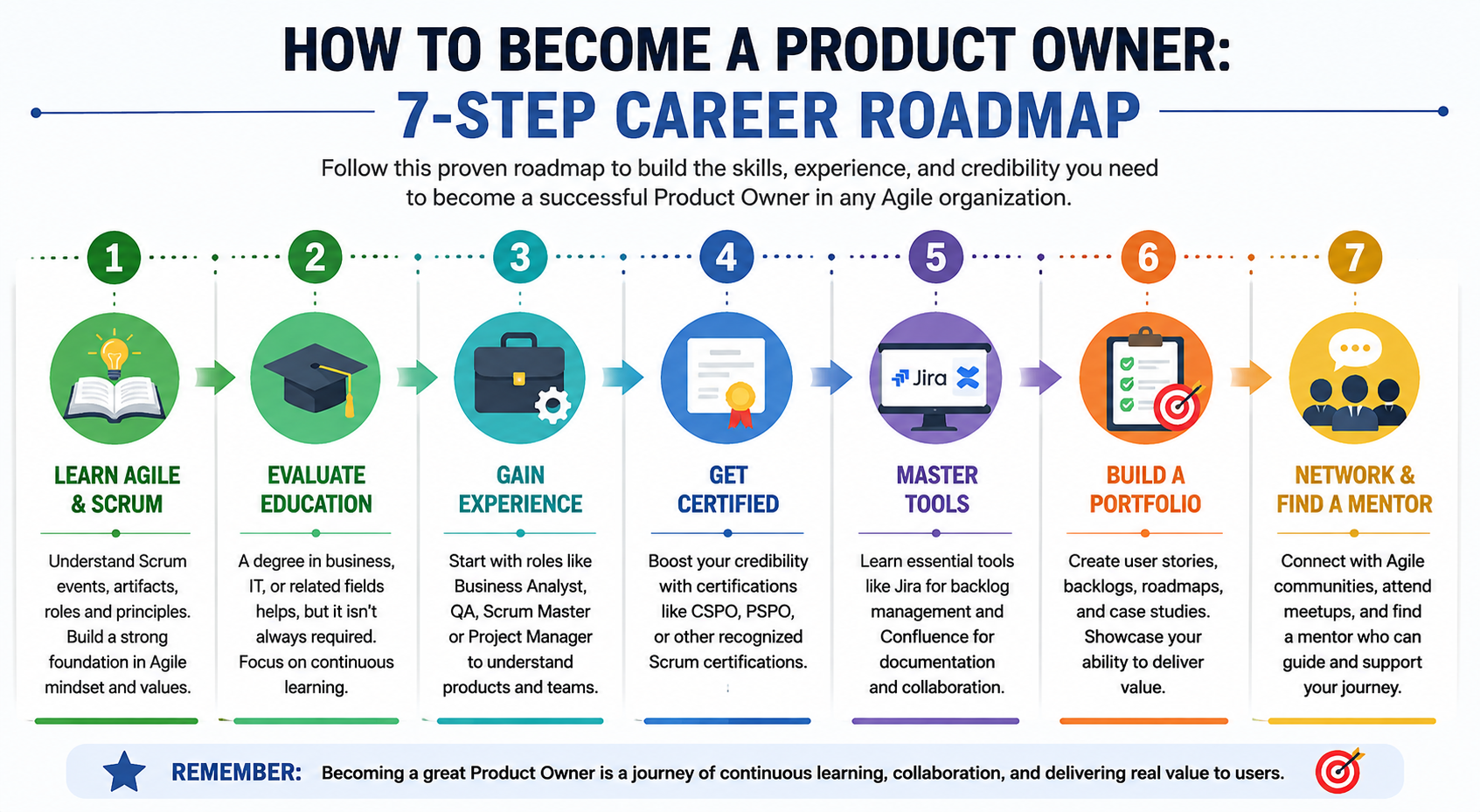
The path most people follow to become a Product Owner is mentioned below in steps, adjusted depending on where you’re starting from.
Step 1: Create a base of Agile methodologies and Scrum
Start with gaining the knowledge about Agile methodologies, going beyond the basic terminological concepts. Study the Scrum Guide, learn how to work with the Scrum framework and get familiar with the backlog terminology. This will be the first meaningful step toward learning how to become a Product Owner in Agile, as opposed to any other project management area.
Step 2: Gain experience, even indirectly acquired
Having a formal job title is not the only way to gain relevant experience. Look for the opportunity to manage a small backlog in the existing job position, to watch a Scrum team or run a side project according to Scrum ceremonies. This is how people figure out how to become a Product Owner with no experience: by creating experience intentionally and not waiting for an opportunity.
Step 3: Obtain a degree or any equivalent technical background
Most companies still prefer, or require, having a Bachelor’s degree, usually in the Business or Computer Science field or some other appropriate one. Having a degree is not a universal requirement, but helps widen the scope of opportunities, especially in bigger companies.
Step 4: Get certified
Certification is the most typical goal for a career changer. Getting a Scrum Certification assures that the candidate knows the Scrum framework beyond its terminology. There are two main ways of becoming a Scrum certified product owner: Deciding to become CSPO certified or Professional Scrum Product Owner (PSPO) certificate. The choice between CSPO and PSPO usually depends on personal style of learning and financial issues. To sum up, the way of obtaining a Scrum Product Owner certification implies going through the accredited training, passing the test and continuing using the skills, being tested through certification.
Step 5: Build a portfolio of your work
Even without a job title, you can build a portfolio: case studies from side projects, a mock product backlog, sample user stories, or a roadmap you built for a hypothetical product. A strong portfolio proves your skills in a way a resume line never will, and it gives hiring managers something concrete to ask you about.
Step 6: Network and find a mentor
Networking inside Agile and product communities puts you in front of people already doing the job. Meetups, LinkedIn groups, and local Scrum gatherings are the easiest entry points.
A mentor who’s worked as a Product Owner can shortcut a lot of the trial and error. Career growth as a Product Owner speeds up considerably once you have a mentor who’s already made the transition, and steady networking keeps new openings visible before they’re posted.
Step 7: Apply, and be specific about your Agile experience
When you apply, tailor your resume around backlog management, stakeholder communication, and any Scrum exposure you have, even informal. This full path is how most people begin career growth as a Product Owner.
How Long Does It Take to Become a Product Owner?
There’s no fixed timeline, but the following range sets a realistic expectation. Starting from scratch with a Bachelor’s Degree takes roughly four years for the degree itself. Add one to two years building relevant experience in a related role, such as project coordination, business analysis, or QA, before you’re a competitive candidate for your first Product Owner Role.
If you’re transitioning from an adjacent role, such as project management, business analysis, or a technical support position, the timeline shortens considerably. With focused effort on certification and portfolio building, six months to a year is a realistic target, since you’re leveraging transferable skills you already have rather than starting from zero.
Best Certifications for Product Owners (2026)
A Scrum Certification isn’t strictly required everywhere, but for most companies it’s the fastest way to prove readiness for the role. The major options compare as follows.
| Certification | Provider | Format | Typical Cost | Best For |
|---|---|---|---|---|
| Certified Scrum Product Owner (CSPO) | Scrum Alliance | 2-day live training + exam | $500–$1,200 | Beginners wanting a hands-on, cohort-based path |
| Professional Scrum Product Owner (PSPO I) | Scrum.org | Self-paced study + online exam | $200 | Self-learners who prefer studying independently |
| SAFe Product Owner/Product Manager (POPM) | Scaled Agile | 2-day training + exam | $600–$1,000 | Professionals in large, scaled Agile organizations |
| Project Management Professional (PMP) | PMI | Training + exam | $400–$700 | Career-changers from traditional project management |
If you’re comparing the two most common entry points, the CSPO leans on instructor-led learning, while pursuing PSPO certification is generally cheaper and more flexible for self-directed learners. Most candidates find it faster to become CSPO certified through a structured course than to piece together self-study alone, especially if career growth is the goal rather than just passing an exam. Either route gets you certified, and both are widely recognized when you’re trying to become a Product Owner for the first time. Many professionals eventually stack both, starting with one Scrum Certification and adding the other once they’re already working in the role, so employers see they’re serious about staying certified and current with the Agile Framework.
Product Owner Career Path
Career growth as a Product Owner typically follows a fairly predictable ladder:
- Associate/Junior Product Owner — supports backlog management under a senior PO, usually 0–2 years in.
- Product Owner — owns a full backlog, works directly with a development team and stakeholders.
- Senior Product Owner — manages a more complex or higher-stakes backlog, mentors junior POs.
- Group Product Owner / Product Owner Lead — oversees multiple backlogs or several Scrum teams.
- Product Manager — shifts focus from execution to broader strategy, market research, and business goals.
- Director of Product / VP of Product — owns product strategy across multiple lines.
- Chief Product Officer (CPO) — sets product vision at the executive level.
This career path isn’t rigid. Some Product Owners move sideways into Product Management, others move into Scrum Master roles, and some stay in a Product Owner Role long-term because they prefer execution over strategy. All three are valid versions of long-term career growth.
Why the Product Owner Role Stays in High Demand
Demand for people who understand Agile keeps growing as more companies move away from waterfall planning and adopt an Agile operating model company-wide.
Job outlook reports consistently rank the Product Owner Role among the hardest roles to fill. This is why it stays in demand even when hiring slows elsewhere in tech, and why the job outlook for Agile talent overall keeps improving. Every Agile team running Scrum needs someone accountable for the backlog, and that need doesn’t shrink as companies scale. It multiplies across more Agile teams, more Scrum Masters, and more backlogs to manage.
If you’re building a case for career growth in this direction, that steady high demand is a strong argument in your favor, alongside the salary growth that tends to follow once you have a CSPO or PSPO listed on your resume. It’s also one of the clearest reasons to become CSPO certified early and use it as leverage in salary negotiations down the line, all while sharpening the communication skills that make the role work day to day.
Product Owner Salary in the United States (2026)
Salary depends heavily on experience level, industry, and location. The following breakdown reflects realistic ranges for the United States in 2026:
| Experience Level | Average Annual Salary (US) |
|---|---|
| Entry-level (0–2 years) | $72,000–$85,000 |
| Mid-level (3–5 years) | $90,000–$105,000 |
| Senior (5–10 years) | $105,000–$125,000 |
| Lead/Group Product Owner (10+ years) | $125,000–$145,000 |
Certifications, a strong skill set, and a Bachelor’s Degree all tend to push the average salary upward. Product Owners working in tech hubs such as the Bay Area, Seattle, and New York typically earn above the national average annual salary for the role. Career growth into senior and lead positions is usually where salary jumps the most. In the US, fintech and healthcare tech also tend to pay a premium over the broader market.
Product Owner vs Product Manager vs Scrum Master — Key Differences
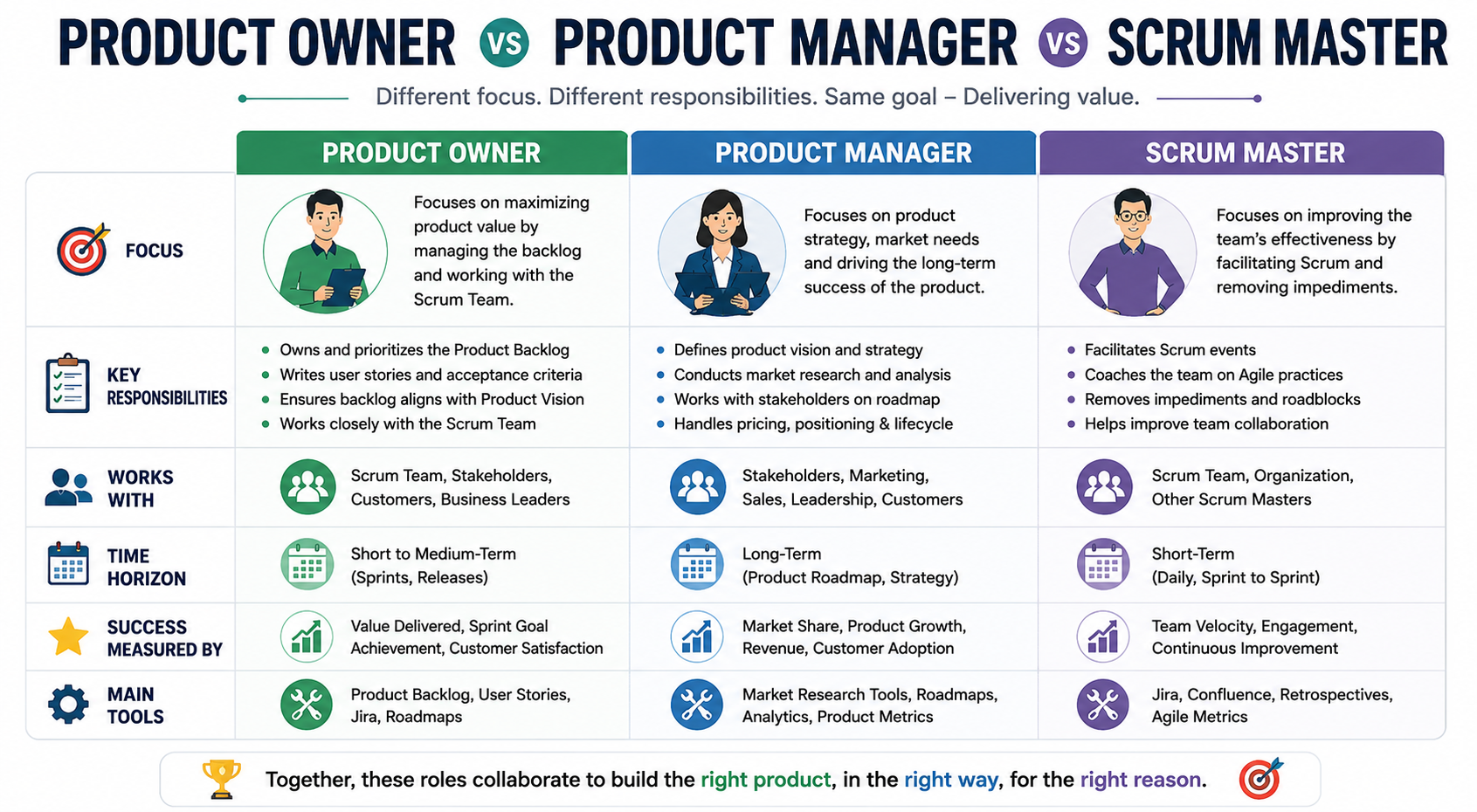
These three roles get confused constantly, and job postings don’t always help. The table below shows the actual breakdown, and the communication patterns each role relies on differ sharply once you look closely.
| Product Owner | Product Manager | Scrum Master | |
|---|---|---|---|
| Primary focus | Executing the product backlog | Setting product strategy and vision | Removing blockers, coaching the team on Agile |
| Owns the backlog? | Yes | Sometimes, at a higher level | No |
| Works most closely with | Development team, in daily sprint work | Executives, marketing, sales | Scrum Team, in process and facilitation |
| Time horizon | Sprint-to-sprint | Quarters to years | Sprint-to-sprint |
| Typical background | Business analysis, project management | Marketing, strategy, engineering | Agile coaching, project management |
Scrum Master vs Product Owner comes down to process versus product. A Scrum Master protects how the team works, while a Product Owner decides what the team builds. Product Manager and Product Owner overlap more, with Product Management covering the “why” and “what” at a strategic level, and the Product Owner covering the “what, right now, in what order.”
Explore the differences between a Product Owner and Scrum Master and learn how both roles work together in a Scrum team.
Product Owner Interview Preparation
Interviews for this role generally test three things: how you prioritize, how you communicate under pressure, and how well you know the Scrum Framework. Interviewers are also weighing your relevant experience against how you’d apply it on their team, so specifics matter more than general communication skills claims. A few ways to prepare for the interview:
- Practice explaining how you’d prioritize a backlog with conflicting stakeholder demands that comes up in nearly every interview.
- Be ready to walk through a user story example from start to finish, including acceptance criteria.
- Know the difference between a Product Owner and a Scrum Master cold; it’s one of the most common interview questions.
- Bring a specific story about a disagreement with a stakeholder and how you resolved it.
- Mention any tools you’ve used, such as Jira, Confluence, or similar product tools, since most teams expect familiarity on day one.
Common interview questions include:
- What’s your process for prioritizing the Product Backlog?
- How do you handle a stakeholder who disagrees with your prioritization?
- Walk me through how you’d write a user story for [a given feature].
- What’s the difference between a Sprint Goal and a Product Vision?
- How do you decide what belongs in the backlog versus what gets cut?
Product Owner FAQs: Skills, Career Path & Certification
What does a product owner do?
A Product Owner manages the Product Backlog, sets priorities for the development team, writes user stories, and acts as the main point of contact between stakeholders and the team building the product.
How much does a product owner make in the US?
The average salary ranges from roughly $72,000 for entry-level roles to over $145,000 for senior and lead positions, depending on experience, industry, and location within the United States.
What certifications do I need to become a product owner?
The most recognized options are the CSPO (Certified Scrum Product Owner) through Scrum Alliance and the PSPO (Professional Scrum Product Owner) through Scrum.org. Neither is legally required, but both make it significantly easier to become a Product Owner, especially without direct experience.
Can I become a product owner without a degree?
Yes. A Bachelor’s Degree helps, but it’s not a strict requirement everywhere. Relevant experience, a Scrum Certification, and a solid portfolio can outweigh the lack of a formal degree at many companies.
What tools do you need to learn to become a product owner?
Jira and Confluence are the two most common tools, alongside basic familiarity with roadmap software and analytics platforms for data analysis.
What does a product owner do on a daily basis?
Daily work centers on backlog management, writing or refining user stories, attending Scrum ceremonies, and communicating with stakeholders and the development team about priorities.
What is the career path from product owner to CPO?
The typical career path runs from Product Owner to Senior Product Owner, then into Product Management, followed by Director or VP of Product, and eventually Chief Product Officer, a shift from day-to-day backlog execution to company-wide product strategy.

PhD, Computer Science · CTO & Co-Founder, GrabAgile Inc.
Dr. Vamsi has spent 20+ years building technology companies from the ground up — through bankruptcy, through rebuilding, and into a global training company that has certified 26,000+ professionals. He knows what it means to adapt when everything around you shifts.
His core belief: “Discipline builds generational strength.” This session isn’t just a class — it’s the career inflection point he wishes he’d had earlier.
- Forbes Technology Council Member
- Stevie Awards Judge — International Business Awards
- Founder of EventCope SaaS — 73,000+ users, $33M+ transactions
- Founder of PumpIQ SaaS — Multi-tenant platform for Indian gas stations
- 20+ years across enterprise & startup technology
- PhD Computer Science · AI Practitioner